Psalm 23:1
The LORD is my shepherd, I shall not want.
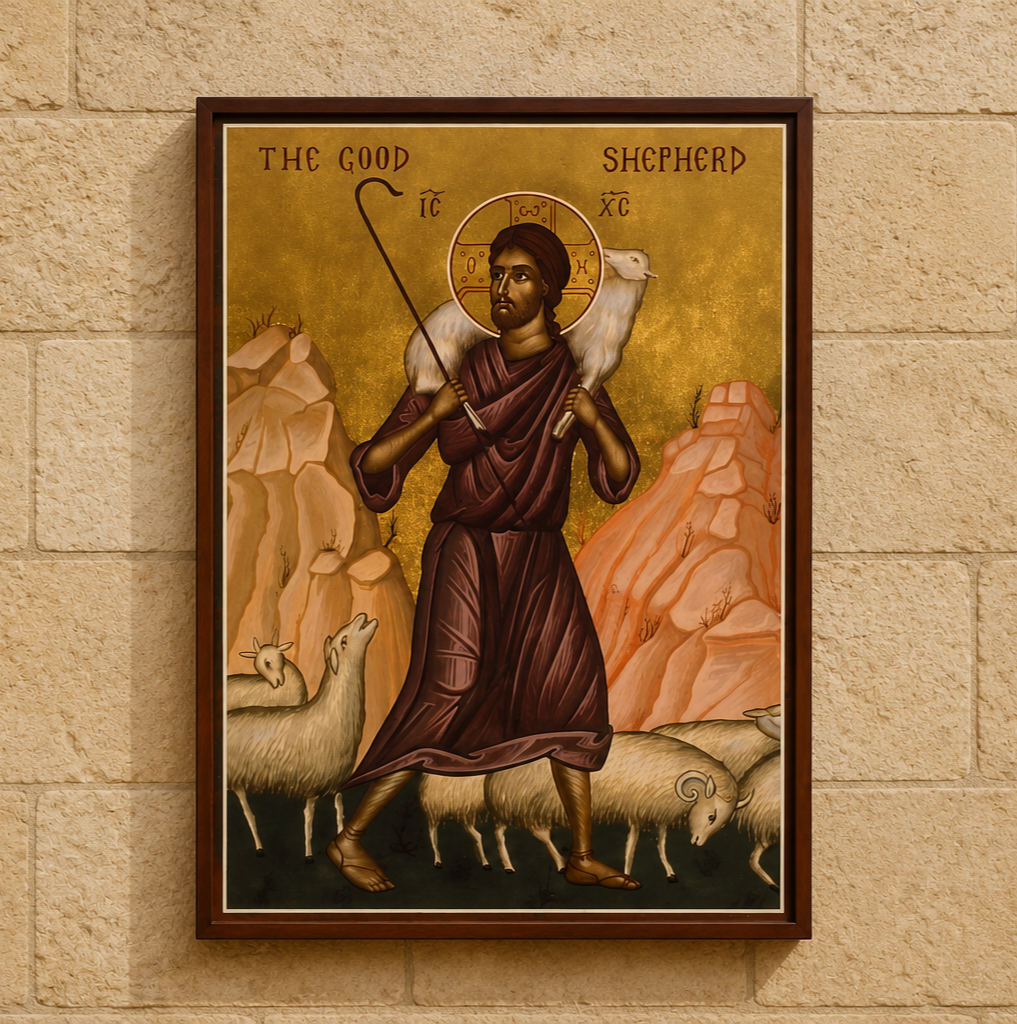
Today is Day 1 of a set of meditations from Psalm 23. Each meditation also includes a section entitled “Going Deeper” for further pursuing the theme of the day’s meditation. If you are interested in this content, feel free to contact me.
Each day, as we prayerfully read through the entire psalm, we will focus on a particular verse or phrase.
Today in the first session we will be meeting the Shepherd whom we will come to see is the Lord Jesus.
Psalm 23 is certainly a beloved psalm, frequently recited at many events. Because it is so common, we tend to let the words flow over our ears, and out of our mind, all the while missing the depth of the individual phrases. Over the course of this study, we will be walking together through the psalm, coming to know the Shepherd personally, as opposed to simply learning information about Him.
As a prayer included in a collection of prayers, this psalm seems unusual in that David, the author, includes no requests of God. Rather, he starts by meditating upon God’s character, speaking to himself, eventually overflowing into words to God of affection and praise. David was meditating on these thoughts not simply for information, but rather as communication with his soul and with God, a meditation which produces transformation.
As we start to look at Psalm 23, consider that this psalm is placed in a particular location with two other psalms. I invite you to read Psalm 22, then Psalm 23, and then Psalm 24 as a set, framing the overall context for these words.
For Each Study, we will be going through six steps:
Relax and Refocus
Read
Reflect
Respond
Rest
Trying it on
I AM the Good Shepherd, and I know my own,and My own known Me,
just as the Father knows Me and I know the Father;
and I lay down My life for the sheep.
John 10: 14 – 15
Relax and Refocus
To enhance your focus, find a spot where you can sit comfortably, away from other distractions as much as possible. Are you thirsty? Even if you are not aware of being so, you may be a bit dehydrated. Hydration supports concentration. Drink some electrolyte water or simply add a pinch of sea salt onto your tongue, then drink your water.
As you pull aside from all the responsibilities, the many cares, the overwhelming burdens of your day, remember that the Lord loves you and He cares about the matters which weigh you down. You can leave them in His hands even now while you take these few moments to seek His presence.
Consider: His stance towards you is open arms, even as the father does in the parable of the “Prodigal Son.” He is inviting you, rejoicing over you, welcoming you into His presence. He does not stand with his arms folded, with a finger outstretched, shaking it at you in condemnation. *
In response to Jesus’ invitation to come to Him, we pray
Lord Jesus Christ,
Thank you that your word is truth. Thank you that you have compassion upon me, even when I don’t seem to understand or am able to live out of the truth that you say to me. Open my heart to you! Enlighten my understanding that I may walk in your ways, following you, my faithful shepherd.
Amen.
He will feed His flock like a shepherd;
He will gather the lambs with His arm,
And carry them in His bosom,
And gently lead those who are with young.
Isaiah 40:11
Tell your heavenly Father what impression comes to your heart and mind from these words. What response do you have to this story of the shepherd and the sheep? How do you envision each of the characters in this parable which Jesus taught?
Pause and Pray
The people of Jesus’ day were well acquainted with sheep and shepherds, being mostly an agricultural culture. They were familiar with their forefathers who had sheep: Abraham, Isaac, Jacob, Joseph when he was searching for his brothers and the flocks, not to mention David before he became king, plus the shepherds who were grazing outside of the city of Jerusalem near Bethlehem. Jesus’ listeners associated the sheep with income and wealth. They knew that sheep could follow their noses into harm’s way and would require the shepherd to go to some lengths and effort to rescue them.
David as a shepherd boy, who was later King of Israel, wrote this psalm out of his own wilderness experience and fellowship with God, whom he called Yahweh. David spent many days over many years guiding his father’s sheep through the circuit of grazing lands, seeking fresh pasture and fresh water, pulling wayward sheep from danger, defending them against predators. He spent many nights out underneath the stars, guarding the sheep, playing his harp. He had known danger, deprivation, in desolate spaces. Over the years of spending time in Yahweh’s presence, he had grown to know and love His heavenly father.
Both by virtue of His relationship with the Father, as well as growing up hearing the Word of God read in the synagogue, Jesus was well familiar with the words of Psalm 23.
Dear Lord Jesus, my Shepherd, please, by your Holy Spirit tune my ears to hear the words of this psalm as if it were for the first time. Please illumine my understanding as I listen and read it and draw my attention to what is your priority for me this day. Amen
The King of love my shepherd is,
H. W. Baker, 1868
whose goodness faileth never.
I nothing lack if I am his
and He is mine forever.
Read
On your first run through this psalm, consider reading it aloud to yourself. Just let the words wash over you without attempting to make an analysis of them right away. What especially catches your attention from the first statement. Read the words in bold using greater emphasis.
Psalm 23
The LORD is my shepherd, I shall not want.
He makes me lie down in green pastures. He leads me beside still water.
He restores my soul;
He guides me in the paths of righteousness for His name’s sake.
Even though I walk through the valley of the shadow of death,
I fear no evil,
for You are with me;
Your rod and your staff, they comfort me.
You prepare a table before me in the presence of my enemies;
You have anointed my head with oil;
My cup overflows.
Surely goodness and lovingkindness will follow me all the days of my life,
The LORD, Yahweh, is my shepherd;
I shall lack nothing.

Reflect
Read again verse 1, this time in another translation.
The Lord is my Shepherd
Our heavenly shepherd understands us. He created us to have a close, transparent relationship with Him. As His creatures, He sometimes communicated with his listeners by having us use our imaginations, giving illustrations from everyday life to enable us to better grasp spiritual realities. The Holy Spirit through David uses this particular illustration, common to those living in ancient times, a picture to which the original hearers could easily relate.
Questions to guide you in pondering the passage
*When you consider who and what a shepherd is, what comes to your mind?
*How is the Shepherd described here in verse 1?
*Where will this shepherd be found with His sheep?
This is where our imaginations depart from the geography and history of that region of the world. The context of the shepherd providing is not in the lush green fields such as what are seen in the photo on this page. David took his sheep out into the wilderness to feed on grassy pastures which he knew of, not where one would usually expect. He needed to move from location to location in order to find appropriate pasture.
Our shepherd provides for us when we are in places where we cannot easily determine how to meet our own needs. He anticipates the needs of His own sheep. He meets us in the wilderness and out of His abundance, He provides for us.
*Consider for a moment: Who is the shepherd?
Just who is the Shepherd?
In order for us to faithfully read our Bibles, to hear what is truly being said rather than what we think is being said, we have tools at hand which enable us to dig deeper.
Using the Blue Letter Bible app or using the desktop site, look up Psalm 23:1, and select the Concordance button. Scroll down the list of words from the first phrase until you see the link for the word LORD.
*Where in the Scriptures do you see God referring to Himself as YHWH?
The word in your Bible marked as LORD stands for the Hebrew word which is sometimes translated as the word Jehovah or Yahweh. We do not actually know exactly how this word is pronounced, but we do know that it is the personal name which God uses when speaking to Moses from the burning bush. This is the personal name which God gives to His people, His people whom He binds himself to in covenant.
He is the one who carefully planned and created every aspect of all Creation. He made Adam and Eve, and you, as His image bearers to be in intimate fellowship with Him, demonstrate His beauty and glory and character, and to steward and nurture all aspects of His world, both visible and invisible. All things belong to Him, visible and invisible, and are under His authority.
*How do these other Scripture references enhance your picture as to who Yahweh is?
*Read 2 Corinthians 4: 7
For God, who said, “Light shall shine out of darkness,” is the One who has shone in our hearts to give the Light of the knowledge of the glory of God in the face of Christ.

*What is your attitude now towards your shepherd?
The Lord is my shepherd
Now put your name in the blank and repeat to yourself: The Lord is _________________’s shepherd.
Not simply “He is a shepherd” or “He is THE shepherd.”
He is personal. He is your shepherd.
I shall not want
Or There is nothing that I need or lack
*When you have a need, not simply a desire, what do you usually do in order to meet it?
*Do you usually assume that you will be able to figure it out?
*What kind of a sheep are we acting like when we live as if we do not have a shepherd who cares for us?
*As our Shepherd is Yahweh,
and He is like the shepherd who seeks after the lost sheep,
as a shepherd who values his sheep—not simply for monetary value,
how does He view our needs?
*How will He respond to us when we go to Him for our needs?
All of Deuteronomy 8 expresses this, but we will focus on v. 15-16.
Use your “W” questions: Who, Where, When, What happens first, next, last
“He led you through the great and terrible wilderness, with it fiery serpents and scorpions and thirsty ground where there was no water; He brought water for you out of the rock of flint. In the wilderness He fed you manna which your fathers did not know, that He might humble you and that He might test you, to do good for you in the end.
Read Luke 11: 9- 13. Use the “W” questions.
“And I say to you, ask, and it will be given to you; seek, and you shall find; knock, and it shall be opened to you. For everyone who asks, receives; and he who seeks, finds; and to him who knocks, it shall be opened.
Now suppose one of you fathers is asked by his son for a fish; he will not give him a snake instead of a fish, will he? Or if he is asked for an egg, he will not give him a scorpion, will he? If you then, being evil, know how to give good gifts to your children, how much more shall our heavenly Father give the Holy Spirit to those who ask Him?
Note for yourself how your heavenly Father responds to you when you turn to Him. Take those thoughts and questions, scribble them down or write them in your journal, and turn them into a prayer.
Pause and Pray
*As the Holy Spirit calls us sheep, then what does maturity in the Christian life look like?
As a friend of mine expressed it, “If there is anything that I need, He is fully capable to leading me to it. I do not have to be anxious, for He will provide it.”
What powerful words spoken by someone who did not have her needs met through the shepherds who were responsible to care for her!
Respond
The poet H. W. Baker observed that when we wander from giving the Shepherd our attention, we will be hungry, we will be thirsty.
When we look to ourselves, rather than to His sufficiency, to provide for our needs, we will suffer.
Pause and Pray
All praise to you, Yahweh, for how you are greater and more glorious a shepherd than I had ever imagined. What love you have for me in your personal care for me, in how you are all power and compassion to provide for my needs, not only physical but also emotional. Please forgive me for being so foolish to think that I can live life so independently. To have my attention so easily pulled away from following you. May I be all the more like a sheep which stays right near the shepherd’s side , the place where I will find provision and protection. May I keep my eyes upon you, rather than following my own nose.
I also pray for _____________________ who needs to know you, Yahweh. Who needs to know the joy of a life living close to your side, ears ready to hear your word spoken to them.
By the power of your Holy Spirit, keep me close to your side, fully in fellowship with you, Jesus. Amen.
Returning to the passage for today, I will pay attention to what the Holy Spirit emphasizes for me from this verse about who Jesus is.
Psalm 23
Yahweh is my shepherd, I shall not want.
Yahweh is my shepherd, and staying beside Him I shall lack for nothing.
*If this statement were not true, how would we rephrase it?
Further thoughts
When life is comfortable, our tendency is to forget that He is the provider and sustainer of every aspect of our lives.
The Scottish hymnwriter, H. W. Baker writes, “When we wander from giving Him our attention, we will be hungry, we will be thirsty.”
Lord Jesus, my shepherd, I want to set my heart fully upon you, giving you my complete attention. I want my soul to long for you, seek you when I sense my needs, rather than looking to anyone or anything else to satisfy my hunger and my thirst.
Rest
In the words of H. W. Baker from his setting of Psalm 23 we pray:
The King of love my shepherd is,
Whose goodness faileth never,
I nothing lack if I am his,
and He is mine forever.
What is on your heart which you would like to say to the Shepherd? What questions do you have? Any confusion or sorrow?
Pause and Pray
I praise you, Father, that you are the King of love! I praise you that your goodness never fails! Thank you that because of your heart for me, I truly will not be helpless, because I belong to you. Yahweh, because you are my covenant God, you are my God! Let me faithfully follow you, not being distracted by other voices. May I joyfully point others to see the beauty and glory of who you are, inviting them to follow you as well.
AMEN
Trying It On
This week, as you go through your daily routine, consider telling your soul both as you awake and as you fall asleep, “The Lord is my shepherd; I shall not want.” When you feel a moment of stress or when your plans for the day have been rerouted, remind your soul of what you know to be true. Pause and recount to Him the ways that He has made provision for you.
Shalom
Listen to H. W. Baker’s setting of Psalm 23 as sung by Michael Card,
“The King of Love My Shepherd Is.”